
Frankenflora
on Margareta Haverman’s A Vase of Flowers (1716)

Last night I watched Guillermo del Toro’s Frankenstein— a glossy adaptation of Mary Shelley’s blistering 1818 novel. Frankenstein is, among other things, a book about monstrosity.
The monstrous can be defined as a transgression of the natural. Like the Minotaur, a harpy, or the Sphinx, Frankenstein’s Creature is a chimera— a composite made up of mis-matched body parts.
Along this vein, there is something monstrous about A Vase of Flowers, a 1716 oil painting by Margareta Haverman now in the collection of the Metropolitan Museum of Art. Like many examples of 17th and 18th century Dutch flower painting, it is an impossible bouquet composed of species that don’t bloom in the same season— an amalgam of flora sutured together in a display of unnatural excess. A Frankenstein of a bouquet, if you will.
Is the comparison too stretched? Maybe. Stick with me though.
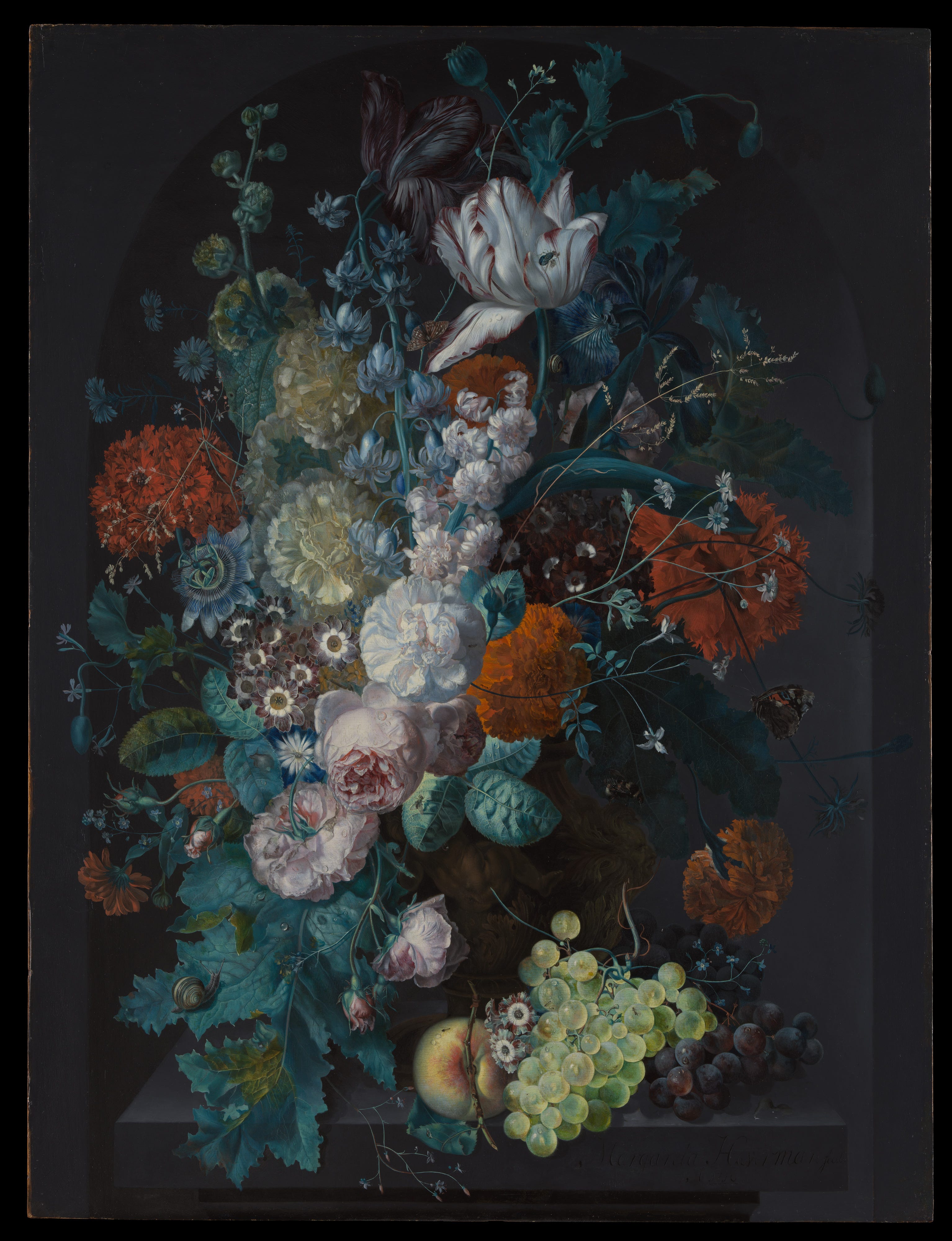
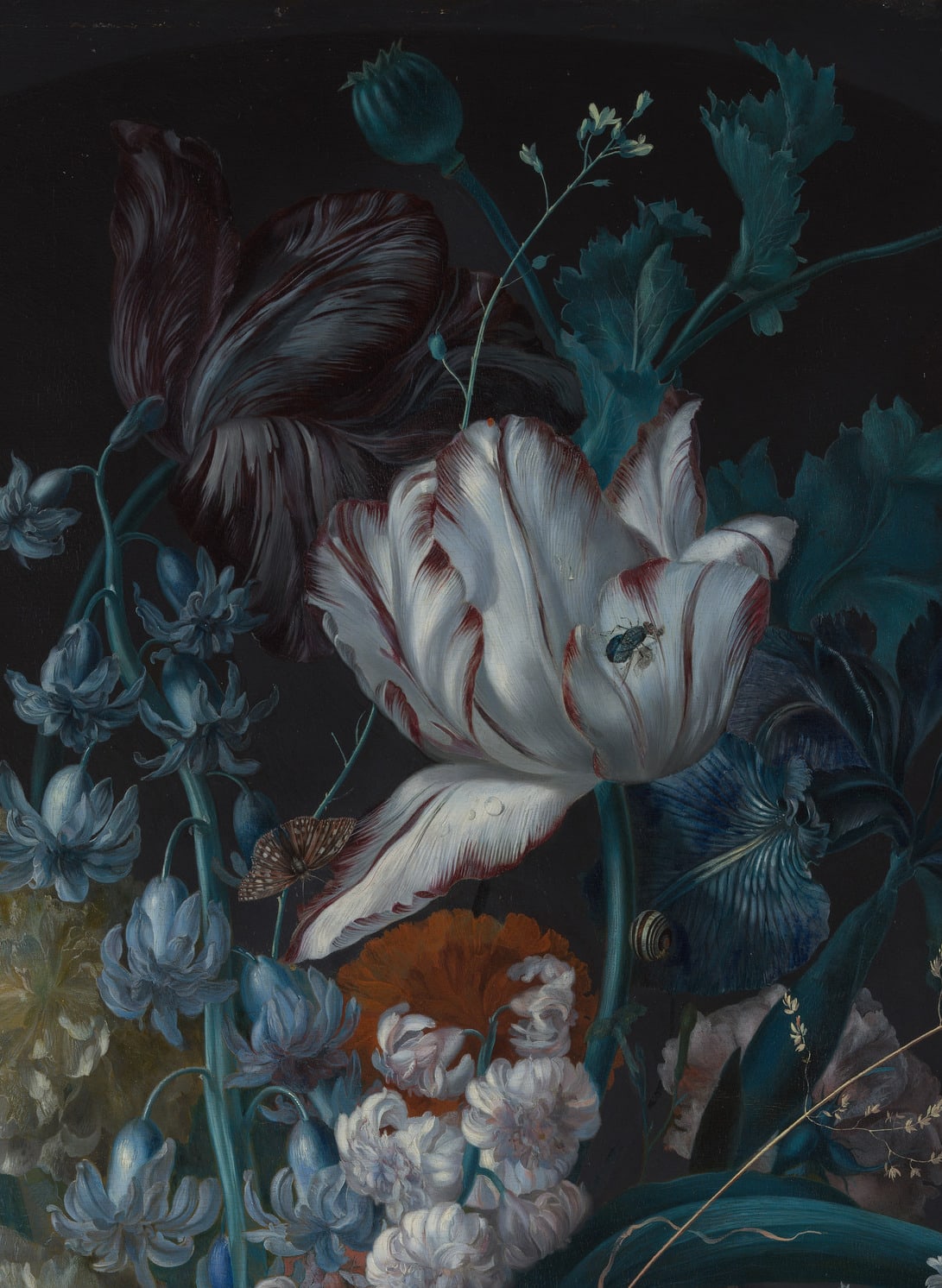
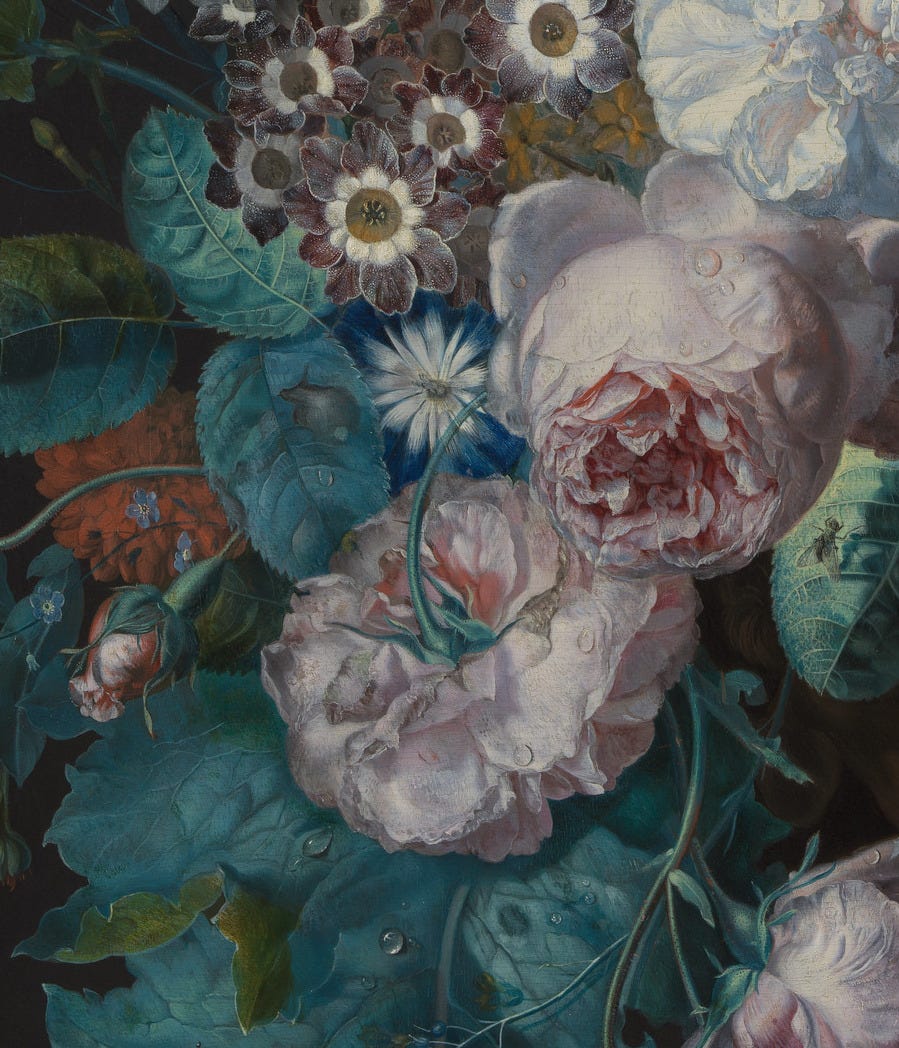
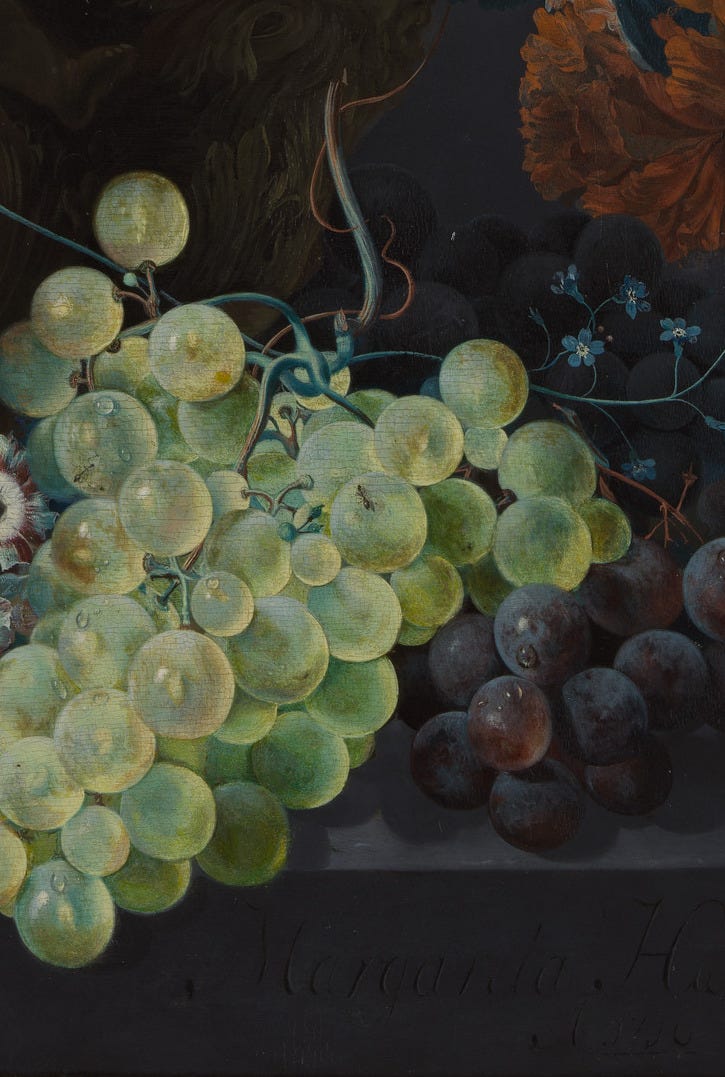
Painted around a century before the publication of Frankenstein, A Vase of Flowers belongs to the tradition of vanitas still life paintings, in which representations of abundance become meditations on impermanence. Look— the tulip is on the turn. A petal droops down away from the others. One of the blousy roses curls and browns at the edges. The grapes look fresh enough for now, but a couple of ants (sometimes a symbol of hard work and diligence in Dutch painting) have already moved in. It won’t be long before more come and make short work of the fruit.
Margareta Haverman (I see it alternatively spelled as Margaretha) was baptised in Breda in 1693. The daughter of an army-captain-turned-schoolmaster, she belonged to a social class in which female participation in the arts was possible but restricted. Like many women artists of the early modern Low Countries, including Rachel Ruysch and Clara Peeters, Haverman specialised in still life, a genre deemed appropriate for women since they were excluded from studying the nude body.
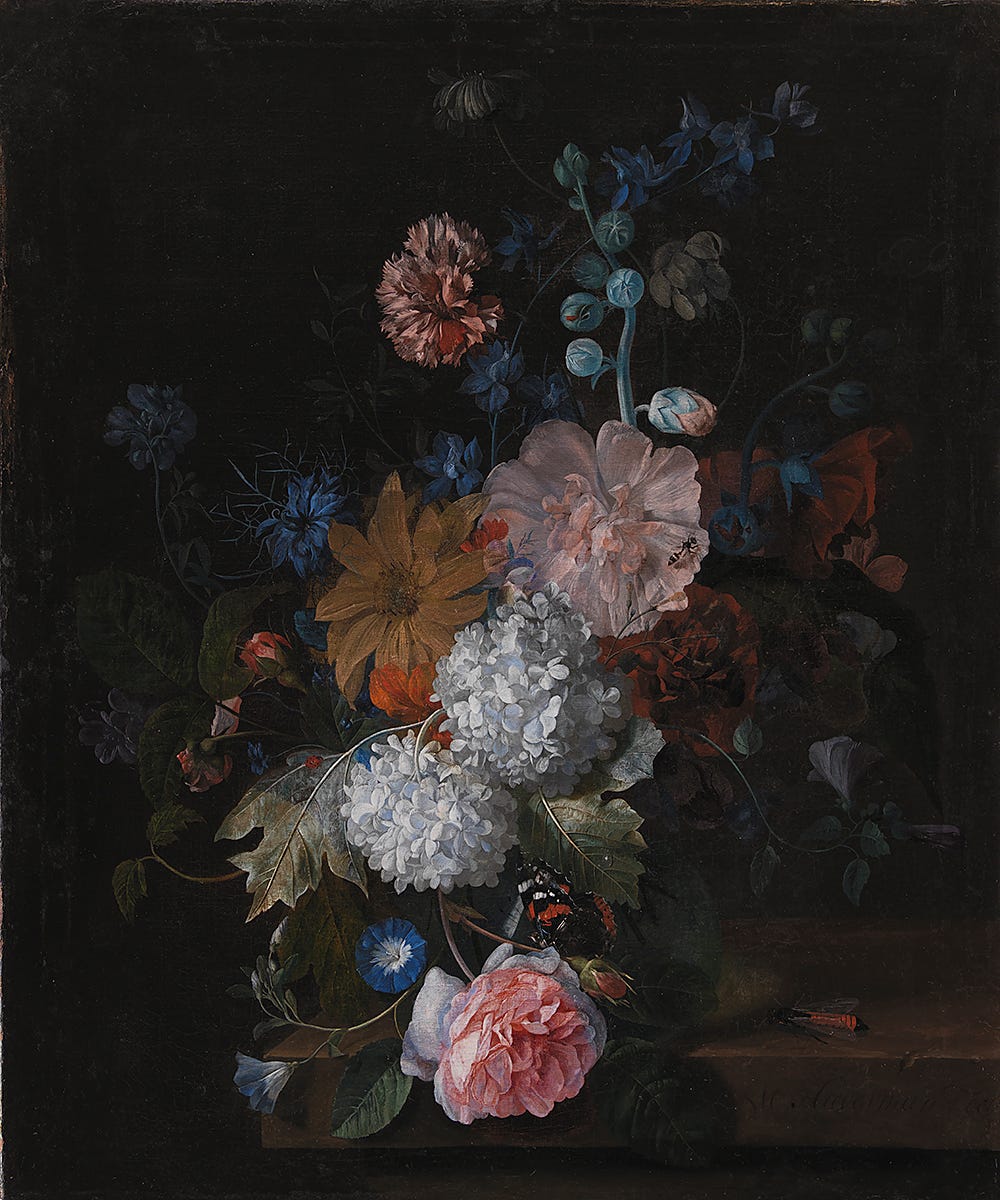
Haverman was a pupil of Jan van Huysum, a celebrated Dutch flower painter. A 1751 biography of Van Huysum records that she both copied her teacher’s works and produced her own flower studies from life. It also suggests that he was jealous of her talent. In the early 1720s Haverman was reportedly expelled from the Académie Royale de Peinture et de Sculpture in Paris for submitting a painting by Van Huysum as her own.
There is no real evidence to support this, and today the claim is generally dismissed as a reflection of a culture that equated artistic genius with masculinity. However, the integrity of Haverman’s work in relation to her gender has been something of a running theme. Henry James (author of The Turn of the Screw) pointedly described her “masculine grasp of the resources of high finish”. In 2005, art historian Fred G. Meijer wrote of A Vase of Flowers that “Van Huysum must have guided Haverman’s brush almost continuously (assuming that she is indeed its author).”
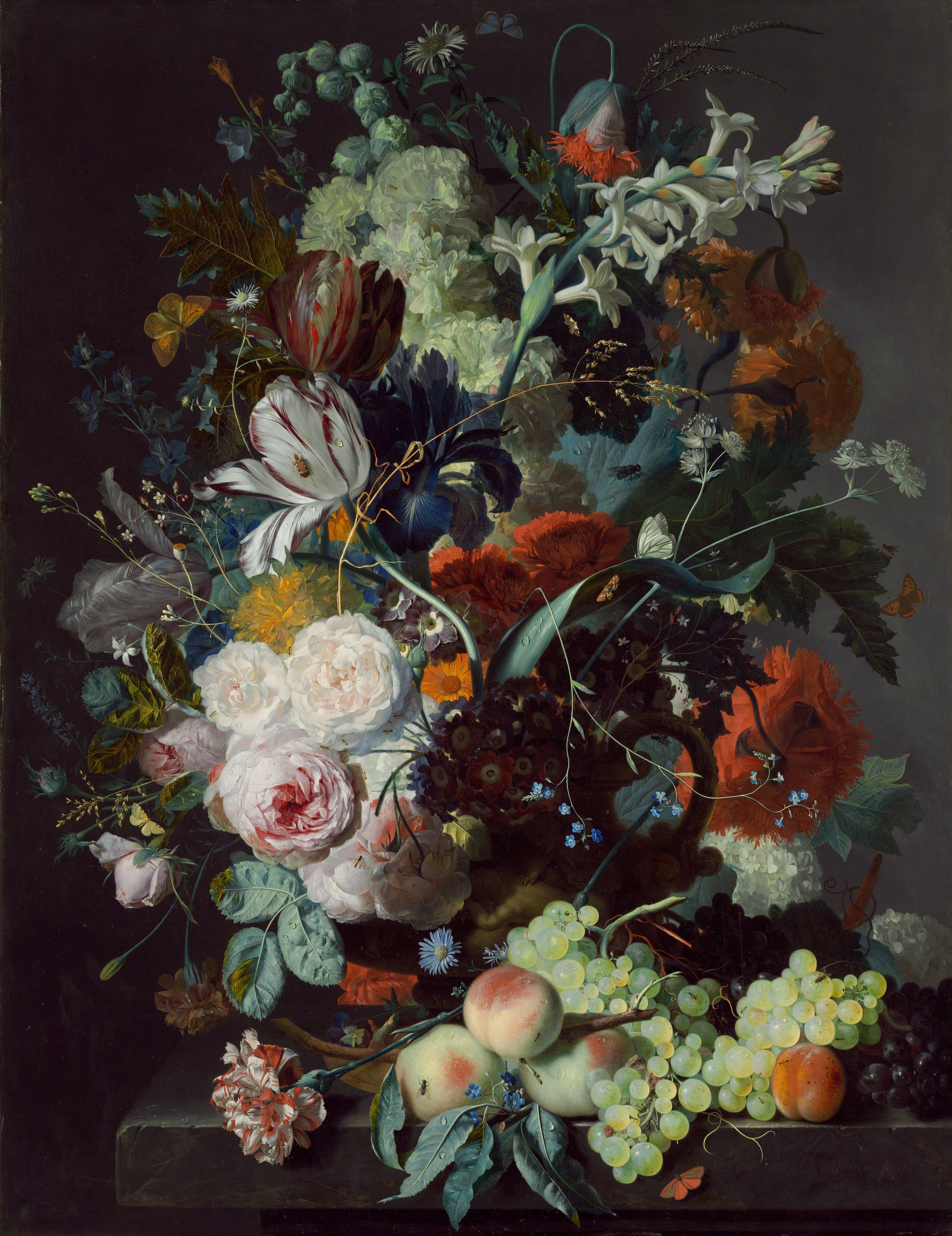
Yet, A Vase of Flowers is unmistakably her own. There’s an incredible analysis of her technique in Margareta Haverman, A Vase of Flowers: An Innovative Artist Reexamined by Albertson et. al.
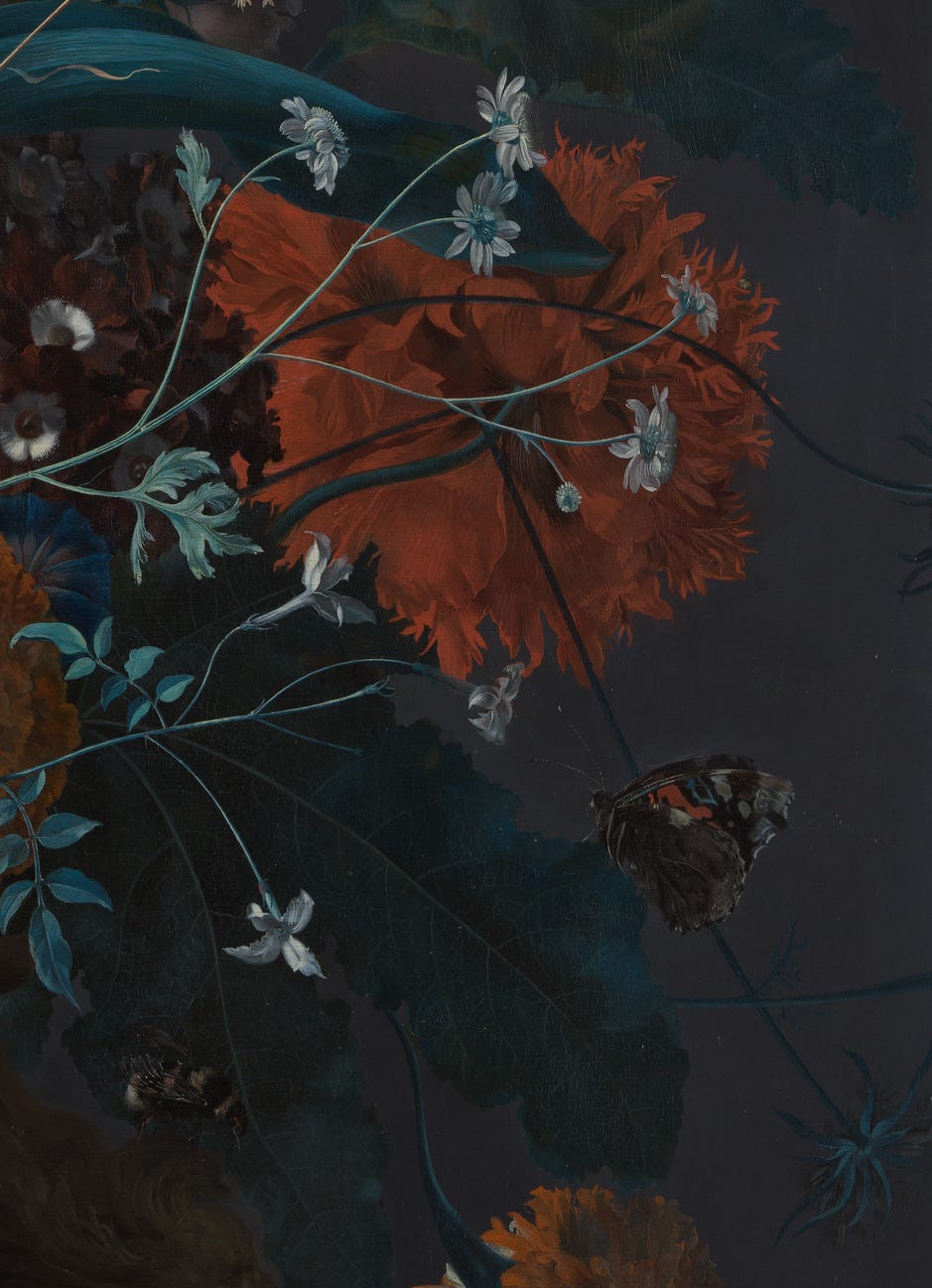
Pigments and the Problem of Prussian Blue
The pigments used by Haverman in A Vase of Flowers are, by and large, typical for her time:
Lead White
Carbon and Bone Blacks
A range of earth pigments, including Red and Yellow Ochre
Red and Yellow Lakes (pigments derived from dyes)
Lead-tin Yellow
Naples Yellow
Ultramarine Blue (made from lapis lazuli- we’re too early for the synthetic version)
A copper-based green
Prussian Blue
The Prussian Blue has been mixed with Yellow Lake and Lead-tin Yellow for the green of the foliage. As the Yellow Lake has faded, the Prussian Blue has become more dominant and the leaves today appear cold and bluish.
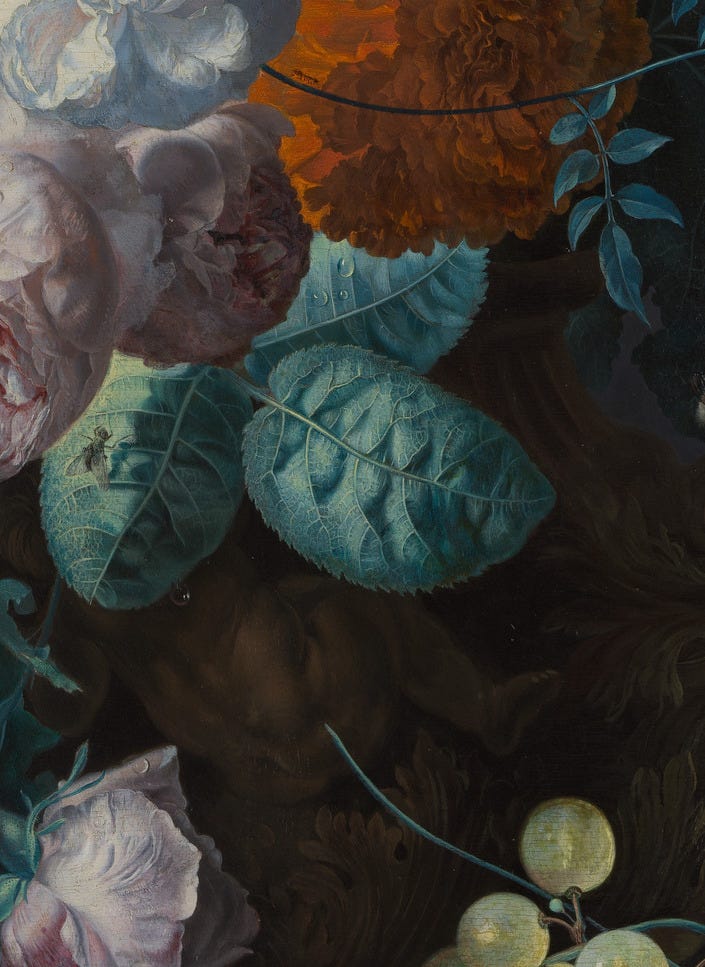
The presence of Prussian Blue is historically significant in itself. The pigment, invented in Berlin in around 1706, was not documented as being commercially available in Amsterdam until the 1720s, making Haverman’s use of it unusually early. According to the Met, this is one of the first known uses of Prussian Blue in Dutch painting.
The question of how Haverman got hold of Prussian Blue before her contemporaries remains open. Jan van Huysum, her mentor, is thought to have used the pigment only after 1722. However, not all of his paintings have been analysed, and I would be interested to see whether he used it in Vase with Flowers (painted 1715, now in Dulwich Picture Gallery’s collection).
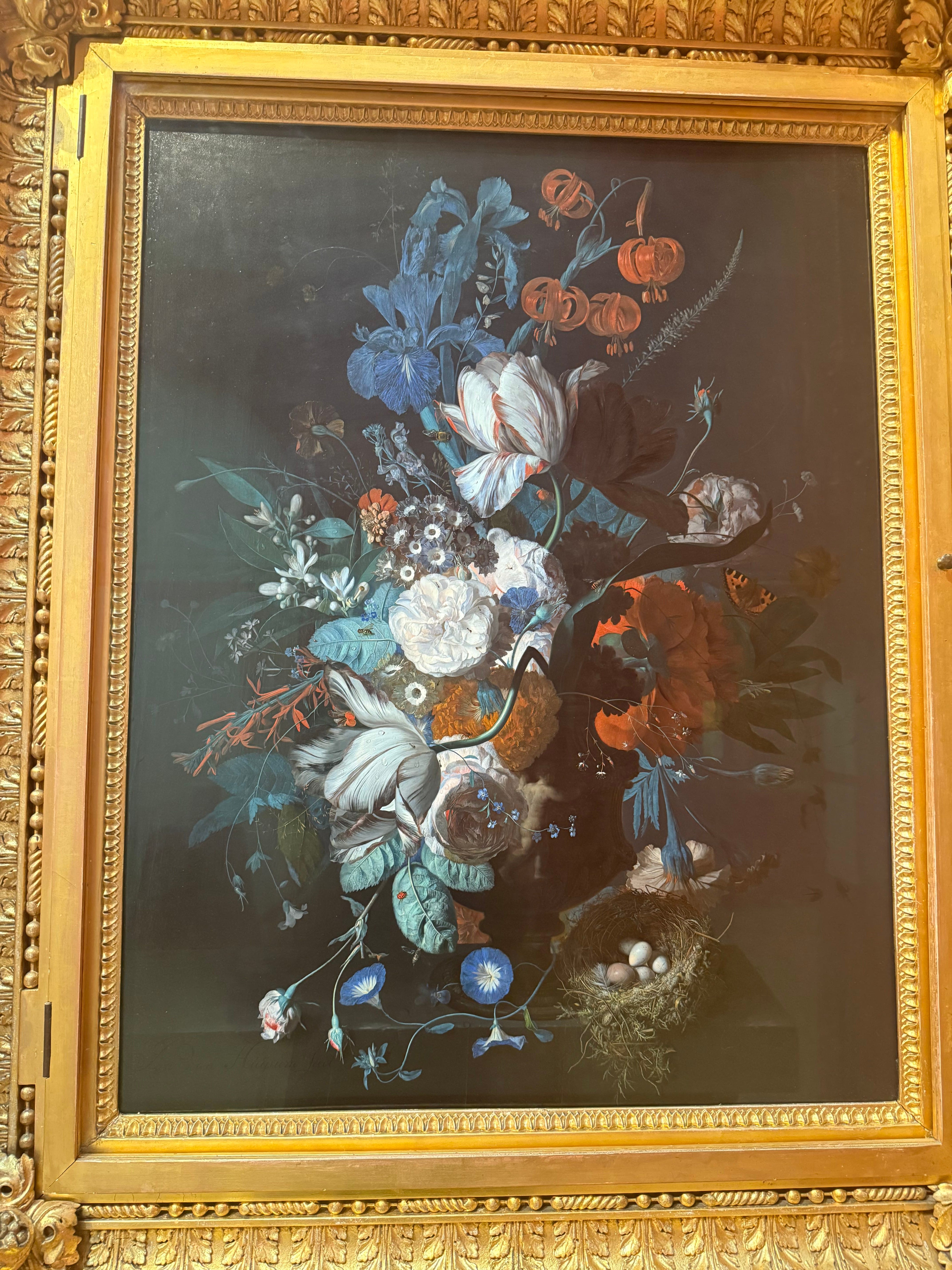
Completed just a year before Margareta’s work, the leaves in Van Huysum’s painting have become blue in just the same way, with the green undertone which is so characteristic of Prussian Blue. I don’t think the possibility that he used the pigment before 1720, and introduced it to Haverman, should be dismissed without looking into it some more.
Another possibility links Margareta Haverman to Rachel Ruysch, the acclaimed flower painter. In 1716, Ruysch returned to Amsterdam from the court of Johann Wilhelm II in Düsseldorf. As a patron of the arts, Johann Wilhelm hosted many artists at his court, including Pieter van der Werff, who is known to have had access to Prussian Blue early on. If the two women met (plausible given their overlapping circles), Ruysch may have introduced the pigment to her younger contemporary.
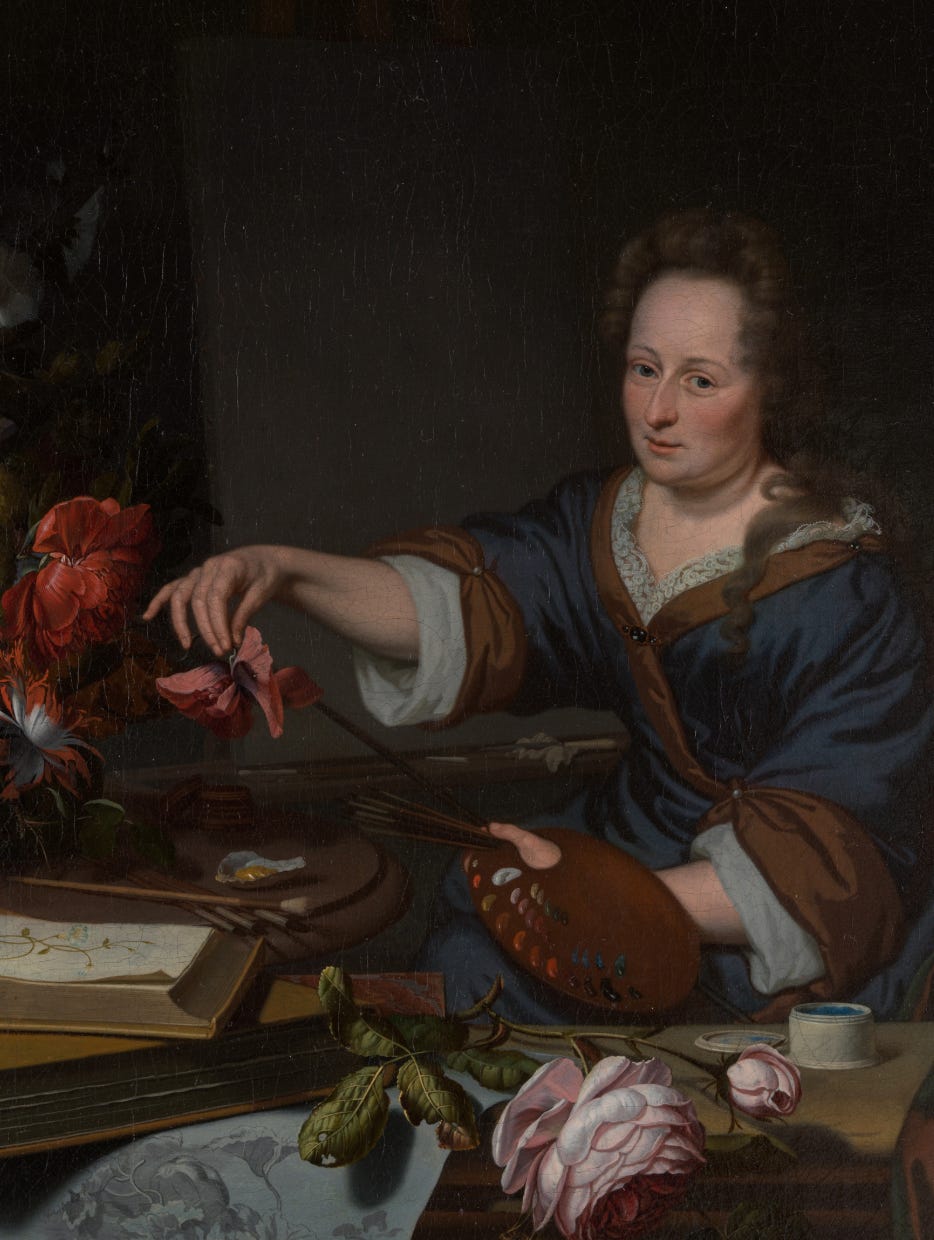
There are only two known paintings attributed to Margareta Haverman (the other is in the National Gallery of Denmark). In the absence of more work, or more biographical details, Haverman is an artist defined by those around her, most notably in relation to her mentor Jan van Huysum. It’s refreshing that her creative and technical brilliance is now being recognised on its own terms.
Why her career ended is unknown. It may have been the scandal surrounding her departure from the Académie, or it may be her marriage in 1721 to architect Jacques de Mondoteguy. A 1730 census records that the couple had children, and societal expectations may have made it impossible for her to continue painting.
To conclude, there’s another thread connecting A Vase of Flowers with Frankenstein.
I have already described Haverman’s use of Prussian Blue, earlier than might be expected. Prussian Blue was invented, entirely by accident, in Berlin during the first decade of the eighteenth century. One of the men involved in its creation was Johann Konrad Dippel. Born at Castle Frankenstein in 1673, Dippel was an alchemist and a radical theologian who, according to rumours that persisted long after his death, experimented with the reanimation of cadavers and the transference of the soul from one body to another. According to one theory, Mary Shelley based the character of Doctor Frankenstein on Dippel. I doubt there is much truth in that, but I don’t think that matters. A Vase of Flowers, like Shelley’s novel, emerged from a world fascinated by the boundaries between life and artifice.
See:
Gerrit Albertson et al. “Margareta Haverman, A Vase of Flowers: An Innovative Artist Reexamined.” Metropolitan Museum Journal, vol. 54, 2019, pp. 143–59
Karen Petersen and J.J. Wilson, Women Artists: Recognition and Reappraisal from the Early Middle Ages to the Twentieth Century (New York: Harper & Row, 1976) pp. 56-58
Chris Baldick, In Frankenstein’s Shadow: Myth, Monstrosity, and Nineteenth-Century Writing, Clarendon Paperbacks (Oxford, 1990)
The overall blue-ish tone of the painting, which I now learnt is due to the faded yellow lake pigment, gives an eerie look to the plants, almost a bit cadaveric, which brings me immediately to think about the memento mori. I find the choice of flowers also quite interesting in their symbolism, especially the passion fruit flower, the poppies and the tulips of the “semper Augustus” type. Still lives and flower paintings can often be overlooked, I love how you’ve turned this one into a fascinating story, a good reminder that every work of art deserves a proper look!
Love this! 🙂
I’m curious to know, what makes you think it doubtful that Doctor Frankenstein was based on Dippel?
Also, have you read Donna Tartt’s, ‘The Goldfinch’? I may be wrong, but I think you may like it 🙂